Mausoleum Project
January 2, 2026
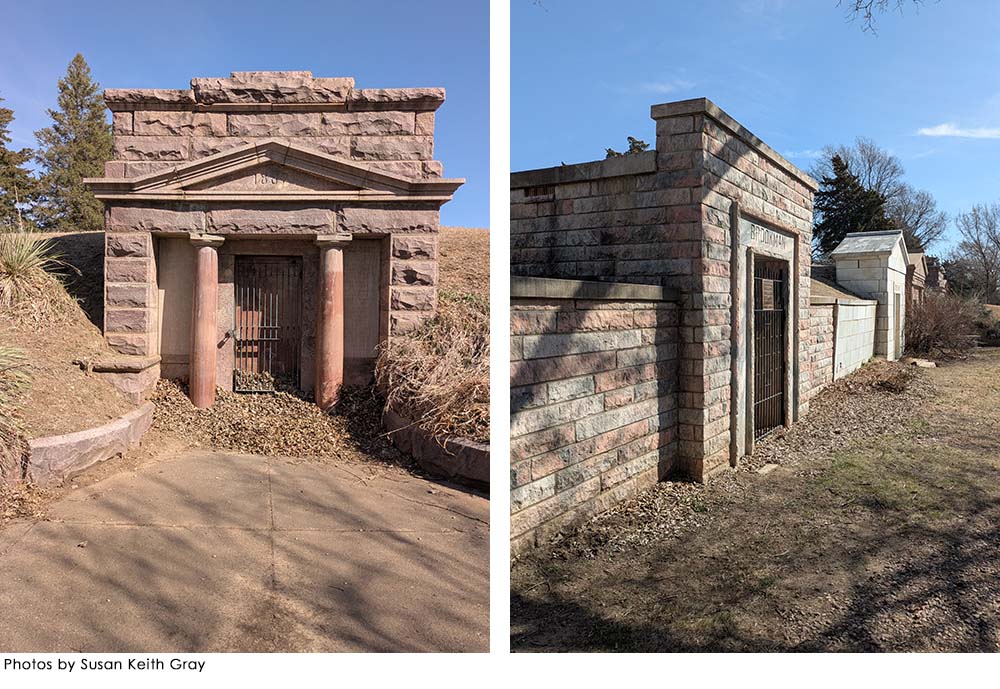
During Fall 2025, the commission began a nomination application of the mausoleums in Vermillion’s Bluff View cemetery to the National Register of Historic Places (NR). Preservation specialist, Michelle Dennis of Rapid City is assisting with the project.
The four stone structures are located on the southwest edge of the cemetery, overlooking the bluff. The oldest structure is dated 1897 with the first burial being of Martin J. Lewis and the most recent being George M. Ferris in 2005. Names on other structures are from the Brookman and Harrington families. Brookman family dates of burials are from 1904-2020. Many dates and names of persons interred are listed but many questions remain.
If anyone has history or stories to share, feel free to contact the commission on the website or at SusanKeith.Gray@gmail.com.
Historic House of the Month: January 2026
January 2, 2026
This January, the Vermillion Historic Preservation Commission (VHPC) is launching its Historic House of the Month project. Each month, the commission will highlight a house in Vermillion that is classified as a contributing property in the National Park Service’s National Register of Historic Places (NR). The house will be featured on the commission’s website and on its facebook page, @Vermillion Historic Preservation Commission. The owner receives a certificate and a sign will be placed in the front yard of the property for the month.
Houses listed in the NR have maintained the historical integrity of their architectural and/or historical significance and are at least fifty years old. Houses may be listed individually or as part of a district. Vermillion has four residential historic districts–University, Forest Avenue, Bluff and Jolley, as well as several houses listed individually. Other local historic properties include the Downtown Historic District, the USD Historical Core District, and a number of individually listed properties.
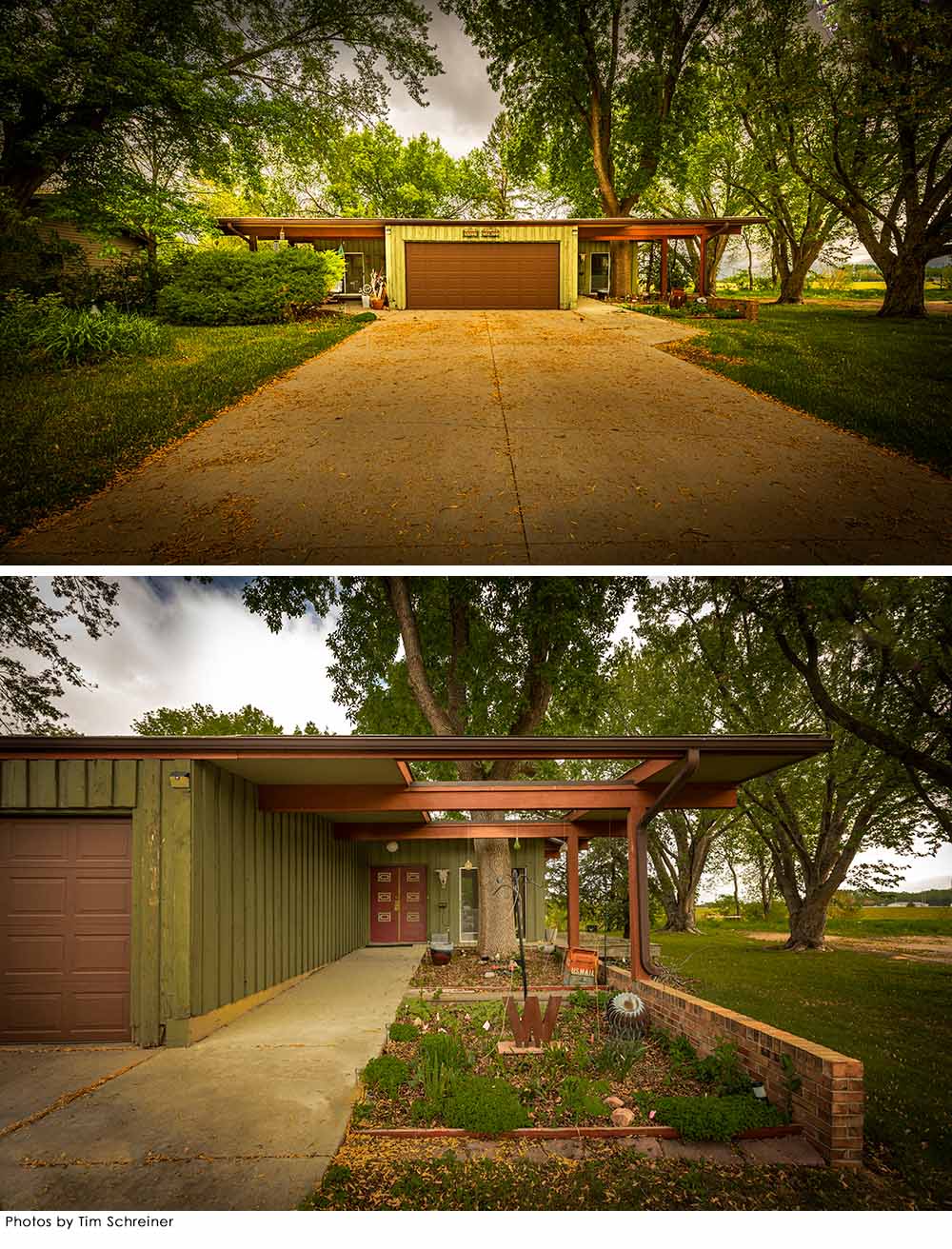
For the first house, the commissioners chose the Jacobson House at 1101 James Street. The owner is Jim Wilson. The Basil H. and Frances Jacobson House was designed by architect John Normile, who was the Building Editor of the Better Homes & Gardens magazine for more than 30 years. The plans for the home were purchased through the Better Homes & Gardens’ house plans service, and the house was constructed in 1968 for the Jacobsons as first owners. It is an example of a Mid-Century Modern style of architecture referred to as the Contemporary style. It has been referred to locally as an “Atomic Ranch” style house.
The house maintains many of the characteristics of this style. This single-family, one-story house has a shallow roof with overhanging eaves. The roof beams extend into the patio and porch spaces in the front and are exposed in the internal vaulted ceiling over the open floor plan.
The style encourages a connection between the indoors and the outdoors. A notable landscape feature is an ash tree growing through the open porch roof. In an atrium in the main living area, plants grow under skylights, in a soil-filled pit. Sliding windows and doors connect to the natural setting outside. Natural materials are used throughout including the large brick fireplace and chimney.
Some changes appear to have been made to the original plan at the time of construction. Minimal changes, perhaps in the 1980s or 1990s, such as kitchen and bathroom flooring, and kitchen cabinets, used matching materials. More information about the Jacobson House can be found in the nomination document at the National Register of Historic Places website, also accessible through the commission’s website.
HISTORIC PRESERVATION COMMISSION DEVELOPS WEBSITE
April 30, 2025
The Vermillion Historic Preservation Commission is proud to announce the development of a website: https://vermillionhpc.org/. This digital platform is designed to inform, engage, and empower residents, property owners, historians, and visitors who have a passion for preserving the community’s architectural and cultural heritage.
The website offers a wide range of resources including information on all of Vermillion’s individual historic properties as well as the historic districts, frequently asked questions, news items relating to historic preservation in Vermillion, and links to other preservation websites. Whether you’re restoring a historic home, researching local landmarks, or simply curious about the area’s past, the new website is your go-to destination. Be sure to check out all it has to offer!
The Historic Preservation Commission encourages community members to explore the site and to take an active role in preserving Vermillion’s rich heritage. If you have historical information to share, please contact us by phone or email at the links on the website.
Vermillion’s Historic Preservation Commission was formed in 2018 and is a volunteer commission that meets monthly at City Hall to plan and implement projects that celebrate Vermillion’s history through its structures. The City of Vermillion as a Certified Local Government (CLG) receives grants from the National Park Service, Department of the Interior through the South Dakota State Historic Preservation Office. The website was partially funded through this grant.
VHPC and CCHPC Co-sponsor USD Campus Nomination for Listing on National Register of Historic Places
March 10, 2025
The University of South Dakota’s historic core - including 13 buildings, two gate posts, and one fountain built between 1883 and 1954 - has been added to the National Register of Historic Places as a historic district. The core of the USD campus is the oldest public university campus of higher education in either Dakota. It was established as the University of Dakota (Territory) in 1862.
The National Park Service, which oversees the National Register of Historic Places, agreed with the South Dakota Historic Preservation Office and two local historic preservation commissions in awarding the district inclusion on the prestigious national register on February, 28, 2025. "The National Register of Historic Places is the official list of the Nation's historic places worthy of preservation,” according to the park service website.
Two buildings within the district were already listed individually on the register - Old Main and Belbas Hall (the Old Armory) - but now 11 more buildings in the area some refer to as “The Quad,” have been added as contributing to the historic area.
Newly added are East Hall, College of Law (now Arts & Sciences), the Old Power Plant (Service Center), University Library (National Music Museum), Chemistry Building (Pardee-Estee Laboratory), Dakota Hall, Slagle Hall and Auditorium, South Dakota Union, McKusick Law Library, Charlotte Noteboom Hall, and Danforth Chapel. The bird bath/fountain in the Shakespeare Garden and the gate posts near the music museum, which once marked the main south entrance to the campus, are also included.
In 1883, the University of Dakota began to take shape with the construction of the west wing of University Hall, which was funded with a Clay County bond issue. University Hall was gutted in an 1893 fire and was reconstructed in similar style as Old Main.
Prior to submitting the nomination, the Vermillion Historic Preservation Commission sponsored a study of campus buildings throughout its history. “University of South Dakota: Historic Context” by preservation consultant, Michelle L. Dennis chronicles the development between 1883 and 1975. Dennis also authored the National Register nomination application.
Newsletter
The Clay County Historic Preservation Commission, the Clay County Historical Society and the W.H. Over Museum publish a joint newsletter three times each year - Fall, Winter and Spring. The activities of the Vermillion Historic Preservation Commission are included. Please visit cchssd.org/newsletter.